Deciphering Time-of-Day Impacts on Progressive Reward Triggers in App-Based Slot Environments
Written by Amir Perry · Aug 25, 2026

Deciphering Time-of-Day Impacts on Progressive Reward Triggers in App-Based Slot Environments
App-based slot platforms operate through networked systems that accumulate contributions from player wagers across multiple jurisdictions, and researchers have tracked how these pools interact with daily activity cycles since the expansion of mobile gaming networks. Data from operator logs indicate that progressive reward triggers occur at varying frequencies depending on the hour, with patterns emerging from aggregated user sessions rather than isolated events. Those who monitor these systems note that synchronization between peak login periods and bonus pool releases creates measurable clusters, particularly when evening hours align with higher concurrent participation rates across regions.
Core Mechanics of Progressive Pools in Digital Slots
Progressive jackpots build through small percentages deducted from each wager and distributed into shared prize pools that span multiple games and operators, while app environments add layers of real-time data exchange that influence when those pools reach trigger thresholds. Studies compiled by the New Jersey Division of Gaming Enforcement reveal that contribution rates remain consistent regardless of clock time, yet the moment of payout depends on the volume of active players feeding the meter at any given interval. Observers tracking these flows report that mobile interfaces often display updating meters that respond directly to collective activity spikes, creating conditions where certain hours accelerate the path to the next win.
Documented Patterns Across Daily Cycles
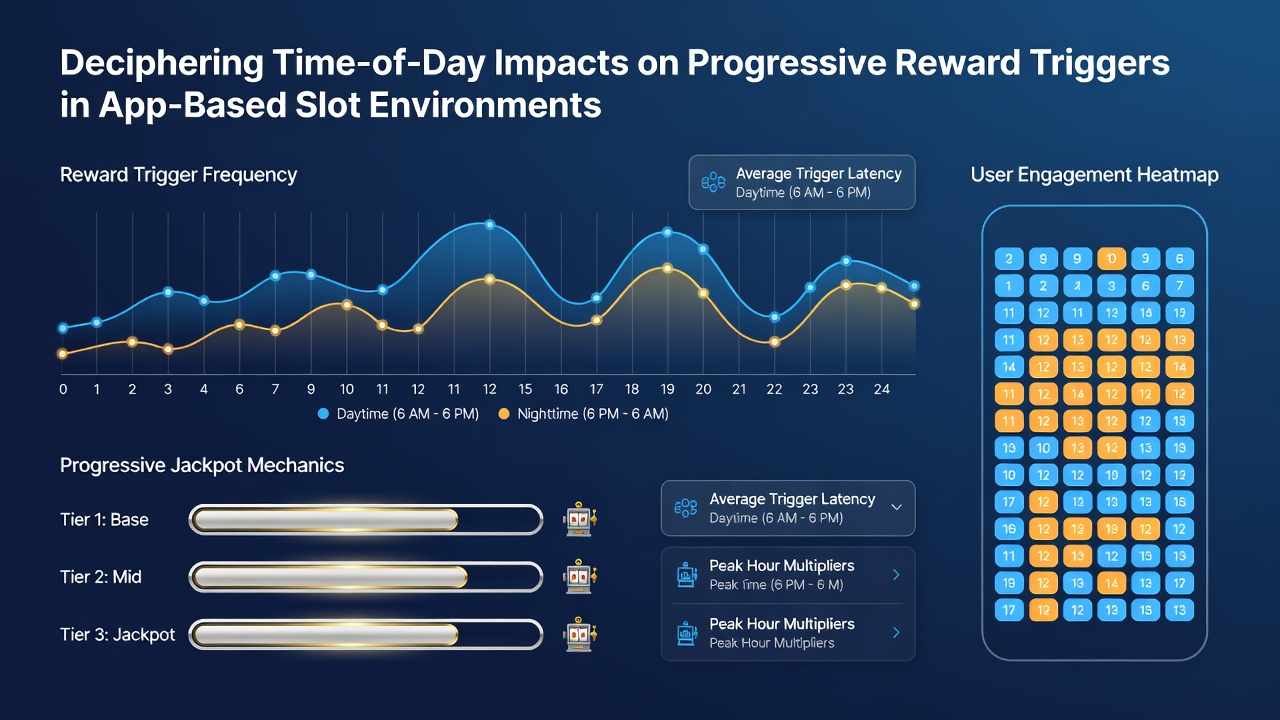
Analytics platforms processing millions of sessions show elevated trigger events between 7 PM and midnight in North American markets, whereas morning hours register lower frequencies because fewer devices connect simultaneously to the same pooled systems. A separate dataset covering Australian operators through August 2026 demonstrates a secondary peak around 2 PM to 4 PM local time, aligning with lunch breaks and commuter patterns that increase app engagement without matching evening volumes. Researchers cross-referencing these records find that the actual trigger probability scales with concurrent session counts rather than any inherent property of the software clock itself.
Regional and Platform-Specific Influences
European markets tracked by the Malta Gaming Authority display flatter distributions across the day because regulatory requirements encourage staggered player access and diverse time-zone coverage within single operator networks. In contrast, single-jurisdiction apps serving only one primary market exhibit sharper peaks tied to local evening routines. Interface design elements such as push notifications timed to user history further modulate these patterns, as developers adjust delivery windows to coincide with historically active periods documented in prior months.
Data Collection Methods and Analytical Approaches
Operators compile timestamped event logs that record every wager contribution and payout occurrence, then aggregate those entries into hourly bins for statistical comparison across weeks and months. University-led analyses from the University of Nevada, Las Vegas have applied time-series modeling to separate random variance from recurring diurnal signals, confirming that certain windows produce statistically significant deviations from uniform distribution expectations. These methods rely on large sample sizes drawn from anonymized player data to ensure patterns reflect genuine behavioral clustering rather than sampling artifacts.
Integration With Promotional Timing
Bonus features and free-spin offers frequently activate during specific windows, and records indicate that operators schedule these incentives to overlap with periods of rising session density, thereby increasing the likelihood that additional wagers feed into progressive meters precisely when triggers become more probable. Cross-platform data exchanges between app stores and gaming servers allow real-time adjustment of offer visibility based on observed traffic, creating feedback loops that reinforce existing hourly distributions. Figures released by the Australian Communications and Media Authority illustrate how such coordinated timing affects overall prize pool velocity without altering the underlying random number generation processes.
Conclusion
Time-of-day effects on progressive reward triggers emerge from the interaction between player volume, network synchronization, and operational scheduling rather than any direct temporal manipulation of game outcomes. Continued monitoring through established regulatory channels and academic partnerships provides the factual baseline needed to understand these dynamics as mobile slot environments scale further.